User:Randyfisher/MP

|
Work in progress, expect frequent changes. Help and feedback is welcome. See discussion page. |
|
Contents
- 1 Welcome to Randy Fisher's Masters Project I page
- 1.1 Paper Feedback
- 1.2 KT & SO
- 1.3 Week 8: Causal Paths
- 1.4 Assignment 5 - Green Hat Perspective (de Bono)
- 1.5 Assignment 4 - Rest Week
- 1.6 Assignment 3: Measuring Success
- 1.7 Assignment 2
- 1.8 Painting the Picture (orig)
- 1.9 Assignment 1, Hudson 690
- 1.9.1 Research Question (variations - trying to get to the right question)
- 1.9.2 1. What is your problem-solving intervention?
- 1.9.3 How do you Plan to Measure Success?
- 1.9.4 3. What are some real world examples?
- 1.9.5 4. What's your basic research design?
- 1.9.6 5. Name at least one (1) Contingency Success Factor
- 1.9.7 6. What's your message beyond the obvious
- 1.9.8 7. What resources are you drawing on?
- 1.10 Links
Welcome to Randy Fisher's Masters Project I page
MA, Organization Management & Development, Fielding Graduate University, California (April 2009)

Paper Feedback
Wayne
- Remove "I" Statements
- No sweeping statements
- Early in paper - be more specific (i.e., going to take X theory and testing the validity of this motivation theory by comparing it to Y theory...research hypothesis early on)
- Erik Moeller no longer on the Board of Governors; he's the Deputy Director of Wikimedia Foundation
- User growth benchmarks in WE, applied to an institution
- propagate internal growth
- Educators have a specific language - discovering that, is part of the relationship building
- Motivators: corporate vs individual driving motivators
- Education (corporate)
- Reduce Cost
- Increase enrollment (access)
- Increase Quality
- Education (corporate)
- Individual (Academics)
- ego
- peer recognition
- peer status - authors in peer reviewed journals
- WE needs a peer review system that meets the needs of diverse (individual) cultures, and of the needs of organizations
- two (2) forces - polarities
- "It's a classic example of a SO system. One is feeding the other in ways that we didn't imagine." - Dec. 17, 2008 - WayneM
2008 Statistics
WE started the year with 2165 registered users and we now have 7012 registered accounts representing a growth of 220% for 2008!
2008 has been an impressive year for WikiEducator and I look forward to 2009 being even better!
Cheers
L4C Performance Interventions
See: http://www.wikieducator.org/Learning4Content/Workshops/Community_Media/L4C_Performance_Interventions
- Email address confirmation, etc.
- Nellie's Feedback page
- Course Layout page
- Build on Apprenticeship model
- Day 2: Add User Name + Network with your peers (i.e., remove People I have trained page)
- Day 2, 3: Start thinking about Structure, Organizing your pages
- Outcome Measures
- Reduce dropout rate = increase conversion rate from Newbies to Active Contributors (sort of)
- Reduce frustration
- Accelerate cycle of collaboration
Chapter on Complexity Theory & Self-Organising Ecosystems
Building a Sustainable WE OER Textbook Initiative
- Google Thread link
- Wayne Mackintosh (2008), Retrieved December 30 from http://groups.google.com/group/wikieducator/msg/84667d28f529a764
(referring to self-organising systems)
I think that the mass-collaboration approach which underpins peer-production models has greater potential for leveraging the benefits of self-organising OER systems (see:http://en.wikipedia.org/wiki/Self-organization ) -- What's interesting about self-organising systems is the fact that its difficult to predict future benefits -- they emerge over time. Also, self-organising systems are also more responsive and can adapt more easily to changing needs. I also have a strong sense that the emerging approaches will be more aligned with the principles of mass-customisation (http://en.wikipedia.org/wiki/Mass_customization ) as opposed to the more traditional model of mass-standardisation we have become accustomed to in the classical academic publishing model. In reality -- its still very early days in the world of mass collaboration and peer-production OER models in education. There is still lots that we need to learn...
- Leigh's post: locally-devised solutions, - local ingenuity, Bolivia, Ivan Illich, etc.
At 2008//12//31 :05:52 AM, Randy's post to Phil, etc. re: Butterfly as the Official bird of the WikiEducator project. Tags: beauty, growth, transformation, metamorphosis, gentleness, creativity, wonder. web Response from Phil: The lesson we try to communicate with it is that without itself struggling, an organism, community, or organization, can not grow to become strong and beautiful. When we do too much for it, it withers."
Randy - Makes sense to me....there's a certain 'survival of the fittest, self-organising, complex ecosystem quality to your comment....I will long remember your perspective.... Retrieved December 31, 2008 from personal email correspondence, December 31, 2008. Re: Butterfly story
Apprenticeship Model
- WikiSkills development
- Online Facilitation
- Other
(keep in mind scalability and sustainability)
Concept Review
For example, your concept review (kits 64 and 65) should compare and contrast what different authors have said about a given concept or hypothesis, in terms such as:
~ These two authors agree on most points, but they differ in their conclusions about X. The reasons they disagree are A, B, C.
~ This author’s findings disagree with mine, but his/her study was flawed by having such a small and biased sample (or by drawing on a research population from a very different situation than the one I am addressing; or …)
~ This author supports my point, but didn’t go as far as I am going in extrapolating her conclusions to start-up companies.
Culture Change
Sometimes you change culture by forcing people to ACT differently, which may be easier than changing actions via culture change. See Pascale, Milleman & Gioja 1997, and their discussion of AARs — a very powerful intervention for getting ideas from employees.)
Go Deep
When I say “go deep,” I mean going into scholarly literature — published journals with peer-reviewed work, reporting on actual studies that have been carried out. Your book list is a good start, but books are usually extended essays, not real research. (See Fieldkit #61 — research is not an essay.)
Meta Learning (Term 1)
The Project as a Personal Experience
The best advice that I can give others, is that if you're cofused, disheartened, and within a phone call to Fielding of pulling the plug, then you're probably on the right track.
Doing a Master's research project is much like developing a slow and intimate relationship with an onion. You peel one layer, to marvel at its complexity and texture, and gain some confidence in your ability to detect and analyze what you can see, touch, taste and smell. Then you you peel the next layer (because it says so on your OMD 690 schedule), and it's a whole new, confusing and disorienting experience.
You let your emotions get the best of you – panic seems like a good option – but in reality, you're moving, well inching and lurching forwardlike (sometimes by falling back, or to the side)... to new level of depth and experience.
You're going to get lost on this Master's Journey, whether you plan to or not. There are just so many nooks and crannies: hypothesis, intervention, outcome measures, devil's advocacy – it's so tantalizing to go off-track, even if you don't want to. Your interest wanders, and your mind tries to rein yourself in, to no avail.
Thought Experiment (TX)
- "It is important to make it clear that the TX (though experiment) is a hypothetical experimental or mental simulation, and not a real event that you are evaluating.
This should be spelled out in the:
- abstract
- introduction chapter,
- opening
- closing para
of the TX chapter itself." - Barclay Hudson
- See Week 2 notes.
- (
 : Post note to Barclay, about wording - TX Chapter itself.)

It's a discipline really: a discipline of the mind, of your heart in response to the metronome beat of an unrelenting class schedule.
Local Culture, Context
Local culture – tall poppy syndrome, etc. ~ Action research is highly contextual, and guided by a sense of time and place. Local history matters; local culture, opportunities and constraints are as important as abstract models of change. Action research needs to be conducted in place, in the context of partners on the ground.
Technology, Collaboration, fear and resistance
- abstract
- Chapter on Control Paradox and Paradigm Shift
- Chapter on KT & SO - "open systems" and collaborative emergence
- fear and resistance, and transition...
KT & SO
See: http://www.wikieducator.org/OMD/641/Journal_Article#Additional_Thoughts.2C_Reflections See: http://www.wikieducator.org/OMD/641/Journal_Article - Journal Article
Week 12: Meta-Learning & Self-Evaluation
Two (actually three) things to address in this final week (and remember, the due date is not Sunday, but Friday, the official end of the course).(A) Self-evaluationsDo not post your self-evaluation in the forum, but e-mail them to me at bhudson@fielding.edu. It’s probably best to provide a brief verbal self-evaluation on each of the criteria provided below, followed by a letter grade on each criterion, in the format A, B, C (with plus or minuses, if you like). Also, provide an overall grade. Some suggested self-evaluation criteria (roughly in order of importance, I’d say):
(1) Final product well written, well-supported, and original. Clear, manageable focus.The final product was well-written, reasonably well-supported and clear.
The focus, well, it's a bit over the map. Some confusion as to which is the domain of WikiEducator, the large self-organizing community, and Otago Polytechnic, the sub-domain. I'm thinking the clear and manageable focus comes next term.
(2) Constructive feedback to others (not just atta-boys but constructive criticism).I do believe I have given constructive feedback to others, and pointed them to gaps in their projects that they might not have thought of, or a different point of view. Even though I was terribly confused, I did my best, to give my best to others.
(3) Timely postingsI was consistently late with my postings, other than this one. Lots of confusion and plenty of panic. I shudder to think of the grade for my work here.
(4) Substantive depth in your postings (critical thinking balanced with conciseness)
Substantive depth...hmm., well, I'm willing to say there was depth. Alot of my critical thinking was turned on myself, and my inability to get out of the jungle truck, to even take a safari trip. Certainly, I was concise, for that I'm sure. But maybe I'm being too hard on myself. (5) Your own criteria, reflecting your own course objectives
I wanted to learn about the master's research process, and for that I've got hair that's a bit more grey, bags under my eyes, and a wife who says she feels neglected. To which, my work supervisor said today, “Welcome to the Academy”.
I've surprised myself with my persistence to get things done, to apply a theory I didn't know much about, to something that I did. I learned (again) that I could really apply a theory, and learn where it fits and where it doesn't. And, I could discuss the heck out of it, so that I could be much more focused and excited about the possibilities about taking another crack at it next time 'round. I'm exhausted yes, but a lot more interested in it, than when I first started.(B) Meta-LearningPlease post this second part of the final assignment at Topic 17 —
The Project as a Personal Experience.
It’s an important capstone to the course this term, and you may want to keep a copy of your posting handy, and compare similar (or perhaps very different) thoughts you might have on meta-learning at the end of next term, when the entire Masters Project is completed. This may provide the most important learning experience of all. It has to do with thinking about the research just completed as a PROCESS.
What was the experience like? To focus this question a bit: What advice would you give to the next cohort (a) while doing the project, and (b) the week before the jazz sessions?So post what you think you have learned about learning in this course. Useful advice is often best if it’s concise and practical, not a rambling stream of consciousness. I keep beating the drum about “meta-learning” (Fieldkit#05 — previously omkit#12 in OMD Hall). A good part of “learning how to learn” is reflecting on what the process was about — what worked, or what to avoid. Ultimately this extends to life management and self-discovery — when is pain bad and when does it have a useful function? How to feel okay about discomfort? (Some people think the essence of yoga is riding that edge, in order to heal rather than pushing ahead to the point of self-injury). What makes a difficult task manageable — hence a motivating challenge rather than a bummer? How do you find your own voice — trusting your own experience — instead of just quoting others? How to take risks? When elderly people near death are interviewed about regrets, they often say, “I wish I had taken more risks.” The master’s project is a pretty safe place to do that. Then again, some people describe the process as a near death experience. Each person’s journey is unique.
My Project as a Personal Experience
The best advice that I can give others, is that if you're cofused, disheartened, and within a phone call to Fielding of pulling the plug, then you're probably on the right track.
Doing a Master's research project is much like developing a slow and intimate relationship with an onion. You peel one layer, to marvel at its complexity and texture, and gain some confidence in your ability to detect and analyze what you can see, touch, taste and smell. Then you you peel the next layer (because it says so on your OMD 690 schedule), and it's a whole new, confusing and disorienting experience.
You let your emotions get the best of you – panic seems like a good option – but in reality, you're moving, well inching and lurching forwardlike (sometimes by falling back, or to the side)... to new level of depth and experience.
You're going to get lost on this Master's Journey, whether you plan to or not. There are just so many nooks and crannies: hypothesis, intervention, outcome measures, devil's advocacy – it's so tantalizing to go off-track, even if you don't want to. Your interest wanders, and your mind tries to rein yourself in, to no avail.
It's a discipline really: a discipline of the mind, of your heart in response to the metronome beat of an unrelenting class schedule.
Next term
Prepare.
Review the course syllabus for next term.
Take the time to review your paper several times, and jot down notes and thoughts for each section; and for what you feel you 'missed' or could have been tighter.
Review the OMD 690 forum notes again.
Write or call your colleagues – and ask for direct feedback pertaining to specific issues that you want to explore in more depth in your paper. Volunteer to do the same for them. Repeat with someone else.
Read the authors and articles that will help you really put flesh on the bones of the theories you're exploring. Use the Fielding Library, and if you can the Library of your alma mater(s) – to get fast access to articles the Fielding Library doesn't have (i.e., Harvard Business Review). It's faster and cheaper to do it this way, than buy the books!
Make sure that you've got a good set of blues tunes available (BB King, Eric Bibb, or Ruthie Foster turned up loud). The blues will always be your friend – before, during and after your Master's Project.
Recognize that you've developed expertise in panic mode. Next time it happens (it will), persevere beyond the pain. Coach yourself to move away from the abyss more quickly than last term. Learn from the experience, and share it with others.
Debrief with your colleagues – past and present. Anyone who's been through the Master's process, will understand.
Trust Me.
Trust Yourself.
Trust the Process.
Week 8: Causal Paths
This paper helped me to remove alot of the clutter in my brain – getting in the way of clarity and a greater sense of where I'm going with this project. By writing down all of the contingency variables that I could think of, and then exploring some of the relationships and assumptions, I can now see why one could go on a 'safari', even if the Master's topic area seemed quite small at the outset. Furthermore, in this context, I have to be aware of these assumptions, while making deliberate, yet thoughtful decisions about what I am trying to explore, and why – and keep focused on that. Otherwise, I'm making a bigger mess in the playpen, and moving no further towards my goal.
While it has taken me awhile to get to even this stage – focusing now on McLelland's theory and using the causal path analysis approach, to explore the research statement: What motivates educators from learning organizations to provide free instructional and learning content on WikiEducator? ; the dependent variable is the provision of free instructional and learning content, and the independent variables are Need for: (1) Power; (2) Achievement and (3) Affiliation. In an in-depth research project, I can now see that focusing simply on one of those Needs would be plenty, let alone three.
Also, the analysis has helped clarify my thinking – and forced me to check my own assumptions. For example, I became involved in the WikiEducator community on the basis of a Need for Affiliation – connecting to a larger community of support....and over time, that has become a singular draw for many an educator. But in doing the analysis, and connecting to the interviews and debriefs I've had with other educators, I've come to realize that yes, this does occur, but it's farther down the line than the other Needs.
Now, I'm thinking that people join a wiki environment on the basis of a Need for Power, but not power in the sense of Zeus taking out a city --- more along the lines of an individual asserting his / her power over his/herself, and destiny. Recently, I read an article referring to a Pew/Internet study (Haymes, 2008) suggesting that:
"49 percent of Americans only occasionally use information and communication technology. Of the remaining 51 percent, only 8 percent are what Pew calls omnivores, “deep users of the participatory Web and mobile applications.” This presents serious challenges to anyone trying to implement technology for the broad user base a typical university or college represents. These challenges are not always apparent to the more technologically minded among us because our perception of technology differs from that of the average user. We usually belong to the 8 percent, while most of our users belong to the other 92 percent."
While I, Randy Fisher, may not see myself as very 'technology-minded' as Haymes suggests, I am certainly in the 8% of the people that he refers to – and thus far, I have assumed that. The path analysis has helped me 'check' that assumption.
Further, this lines up with feedback from WikiEducator Users who want to be current with technology and try out its various nuances and applications, in a safe environment. (We have received this feedback via training exit surveys and telephone interviews). Thus, while the safe environment 'includes' the community of support, the real reason that educators appear to be joining WikiEd, at this phase of its development, has to do with a greater sens of power over their own professional development. Next comes their sense of achievement, and in turn their belonging to a community of practice. These three needs being met, at different times with different emphasis, affect the quantity and quality of instructional content that is freely developed on WikiEducator.
References:
Haymes, Tom (2008). The Three-E Strategy for Overcoming Resistance to Technological Change, in EDUCAUSE Quarterly, vol. 31, no. 4 (October–December 2008)
Assignment 5 - Green Hat Perspective (de Bono)
Assignment 4 - Rest Week
Assignment 3: Measuring Success
My Hypothesis
- Collaboration among siloed educators (in educational organizations) will increase, with the support of an effective Wiki-Community-Builder.
- Membership in an open wiki, will result in increased contribution and sharing between, and among educators in educational organizations.
- Educator participation and contributions (and collaboration) will increase when educational organizations use open wikis for curricula development.
Research Context
The research measures success in Phase 3 of WikiEducator's development - prioritizing activities for collaboration and implementing open educational resources (OERs) into mainstream educational activities, in real educational contexts. Previous phases involved setting up the technologies, processes and initial content resources to facilitate community development and international collaboration on OERs using wiki technology; and scaling up the rate of OER content development
The People who support the WikiEducator project are the educators, learning designers, multimedia and technology support individuals who form the WikiEducator community. This includes organisations and institutions. In the case of a single educational institution, this would involve educators, learning designers, multimedia and technology support AND administrative and executive support people.
The collaborative development of OERs can make significant financial and other contributions (in line with the aims of this Research Project) to:
- Removing the barriers to active and meaningful collaboration among educators (formal and informal), regardless of educational level, language, culture, technology, and geography
- Improving the time-to-implementation and quality of free educational content, and improving the opportunities for the appropriate local use of these resources.
- Reducing costs through appropriate use of scalable information and communications technologies, economies of scale and disruptive business models.
Collaborative Project Development (on WikiEducator)
-
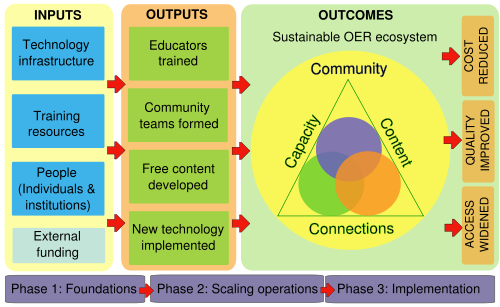 Figure 1: WikiEducator's Logic Model

- Number of educators trained and educational departments represented
- Departmental spread of training interventions
- Number of user accounts registered on WikiEducator
- Rate of conversion from Newbie to Active Contributor
- Growth in visitors to the WikiEducator site (by departments)
- Number and nature of community projects, clusters and regional nodes formed on WikiEducator
- Number, diversity and growth of:
- individual and departmental requests for collaboration
- "legitimate" collaborative content development projects initiated on WikiEducator.
- strategic collaborative projects between individuals within one department, between departments, and between groups from different departments (i.e., silos)
- completed projects / units (i.e., units, course elements, learning activities - to be defined)
- editors per page (i.e., role, culture, status, educational discipline, number of edits, quality assurance as determined by peer review)
- active contributors per WE space
- Degree of collaboration (absolute numbers, by %, by perception, and over time)
- Increase in the pedagogical quality of content developed collaboratively:
- per educational level (i.e., primary, secondary and tertiary);
- per sector (i.e., formal, non-formal and technical and vocational training);
- per application (i.e., learning activities, curricula, learning objects including multimedia, textbooks)
- Number of courses implemented and taught using collaborative content
- Amount and growth of financial and in-kind resources for collaborative project development
Qualitative
- Assess users' perceptions, fears and behaviour regarding technology, information-sharing and other barriers to collaborative project design, development and implementation.
Community Building (Increasing Effectiveness)
- Growth in user participation and requests for collaboration (i.e., input to another educator's project; development of one's own with a team, input to a strategic collaborative project)
- Number of introductions, % change in relationship-building activities
- Number of facilitated dialogues (individual, forums)
- Number of retained and new members, % changes over time, trendlines
Qualitative
- Assess changes in Community Builder's approach to introducing people based on users' activity patterns and differences between Newbies and established users, cultural / sub-cultural information, interests and user needs and priorities
- Assess changes in user perception of overall experience, satisfaction and behaviour regarding introductions, collaborative project development, implementation and followup
- Assess alignments between individual and community projects to increase sustainable collaboration with WikiEducator / educational departments.
My Questions
- As the Reader, do these make sense to you? (I want to make sure that they are in line with the Hypothesis
- There are dollar values to these "numbers" ~ but I'm thinking the numbers are most important to the individual department making an 'investment' in collaborative project collaboration - I did not put in a line about estimating the cost of contributor's time doing collaborative project development the wiki-way, vs. the traditional way ~ is this correct, in your view? Should I have some measure for this?
- Have I missed something ~ does this make sense?
- Feedback - Assignment 3
Assignment 2
Brief intro
In April 2007, I joined an international community of progressive educators who sought to plan education projects linked to the development of free content (and e-learning) and work on building open educational resources (OERs) in line with the UN's Millennium Development Goals. WikiEducator is dedicated to achieving a free and open version of the world's education curriculum by 2015, and rooted in the values of openness and freedom, as defined by the Freedom Culture. All software used on WikiEducator is open-source.
WikiEducator’s registed user base has grown steadily from 1 (Feb. 2007 to 6000+ registered users (Nov. 2008),. and currently is in the world's top 165,000 websites - http://www.alexa.com/data/details/traffic_details/wikieducator.org (as of October 19, 2008), Users (formal and informal educators) join due to motivated self-interest. The latest survey of new account holders reports that a majority of users have joined because of interest in using, testing and evaluating new technologies and applying them to the domain of learning and education.
I decided to use my community-building, facilitation and networking skills to support the WikiEducator project (and community) to achieve its goals. I focused my efforts on facilitating the most active users towards developing strong dyads and clusters within the community, aligned to WikiEducator’s Strategy and Framework - Strategy & Framework - http://www.wikieducator.org/WikiEducator:About Over time, pockets of sustainable community activity came together, yet it was unpredictable - some times it gathered strength immediately; at others, it grew slowly, sputtered and then reemerged later.
To date, the project has achieved its targets significantly ahead of schedule - in terms of users, content, timelines, geographic reach and scale. See a "Concise History of WikiEducator": http://wikieducator.org/WikiEducator:WikiEducator_3.0#A_concise_history_of_WikiEducator
Painting the Picture
Sitting at her dask, her laptop closed for the night, N stretched back in her chair, hands outstretched and clasped above her head. She sighed happily, and flashed a smiling grin that leapt across Tel Aviv and beyond. For several long memorable moments, she revelled about the Art of the Possible.
Six months earlier, Nellie, a passionate Israeli-Canadian teacher in her final year of a Ph.D., dreamed about exchanging K-12 lesson plans and collaboratively developing new learning activities with educators from around the globe. (It was hard to find enough people in her organization who wanted to do it.)
She joined several social networking sites on the Internet and took on leadership and moderating roles to become more involved in their communities. But she was still missing that experience of working together with her peers.
During an online conference of Canadian educators, Nellie was contacted by RF, an educator from Canada ~ who was interested in her experiences living, learning and working in Israel. RF introduced himself as a Community-Builder for the WikiEducator project. He shared the project's vision to create a free and open version of the world's education curriculum by 2015 (in line with the UN's Millennium Development Goals), and a community of educators around the globe working together.
They arranged to meet using an online phone service "Skype" to learn more about each other and their interests. (In the meantime, RF sent N some links to pages on WikiEducator site to give her a picture of the project's scope, connections and possibilities. (RF, was showing Nora the project's credibility, as after all, they were strangers.)
During the online phone call, Nellie & RF shared their their interests and identified areas of common ground for working with other educators in the WikiEducator Community.
After that conversation - RF (using his relationship equity) introduced Nellie to other educators in the WE Community, based on their mutual interests, so that they could work together on various projects, on the wiki.
Results
As a result of these trusted introductions (and each person's follow-through behaviour) -- educators were able to expand their sphere of influence and relationships; bridge across silos (i.e., thinking, access to resources, critical self-judgments, and perceptions); and add value to each other's efforts ~ and the larger WikiEducator project.
Future Directions
- If the CB could increase his effectiveness at linking people ~ by knowing more about their culture and pyscho-social reactions - would these connections be more enduring?
- Would these connections lead to the production of OER content (i.e., WikiEducator sustainability)?
- Could other CBs apply these "lessons" to their own educational organizations to support greater collaboration, within a self-organizing global wiki community?
- What leadership examples or organizational change practices exist from progressive organizational environments that could be compared and / or contrasted with these emerging practices?
Orienting Notes
- Connecting
- an action which introduces other people, finds common ground, clarifies cultural and other differences, interests and positions, breaks down barriers, forges relationships, organizes and involves others, gives feedback and information about resources for content development and performance improvement.
- Supports the development of relationships: 1-1, 1-many, many-1
- Silos - can exist as one person, or a group
- Collaboration can be as simple as "working together"....it can also be measured in degrees in terms of "active collaboration".
The Research Questions
To examine how to increase collaboration and content development for a global community of educators, in a self-organizing wiki environment.
My hypothesis
Collaboration among siloed educators (in educational organizations) will increase, with the support of an effective Community-Builder.
My intervention (solution):
Phase I: Evaluation
1. After Action Reviews (Pascale, 1997) 2. Managing (Cultural) Resistance to Change (Kotter, 2008)
Phase II: Participatory Action Research
References
- Booth, Wayne C., Gregory G. Colomb, Joseph M. Williams. (2003) The Craft of Research. 2nd edition. University of Chicago Press.
- Kotter, John P. and Leonard Schesinger.(2008) "Choosing Strategies for Change." Harvard Business Review, July-August 2008 [HBR reprint #R0807M]
- Pascale, Richard, Mark Milleman and Linda Gioja (1997) “Changing the Way We Change. How Leaders at Sears, Shell, and the U.S. Army Transformed Attitudes and Behavior -- and Made the Changes Stick.” Harvard Business Review 75:6 (Nov 97), 126-139. [HBR reprint #97609]
Painting the Picture (orig)
Sitting at her dask, her laptop closed for the night, N stretched back in her chair, hands outstretched and clasped above her head. She sighed happily, and flashed a smiling grin that leapt across Tel Aviv and beyond. For several long memorable moments, she revelled about the Art of the Possible.
Six months earlier, Nellie, a passionate Israeli-Canadian teacher in her final year of a Ph.D., dreamed about exchanging K-12 lesson plans and collaboratively developing new learning activities with educators from around the globe. (It was hard to find enough people in her organization who wanted to do it.)
She joined several social networking sites on the Internet and took on leadership and moderating roles to become more involved in their communities. But she was still missing that experience of working together with her peers.
During an online conference of Canadian educators, Nellie was contacted by RF, an educator from Canada ~ who was interested in her experiences living, learning and working in Israel. RF introduced himself as a Community-Builder for the WikiEducator project. He shared the project's vision to create a free and open version of the world's education curriculum by 2015 (in line with the UN's Millennium Development Goals), and a community of educators around the globe working together.
They arranged to meet using an online phone service "Skype" to learn more about each other and their interests. (In the meantime, RF sent N some links to pages on WikiEducator site to give her a picture of the project's scope, connections and possibilities. (RF, was showing Nora the project's credibility, as after all, they were strangers.)
During the online phone call, Nellie & RF shared their their interests and identified areas of common ground for working with other educators in the WikiEducator Community.
After that conversation - RF introduced Nellie (using his relationship capital) to other educators in the WE Community, based on their mutual interests, so that they could work together on various projects, on the wiki.
Results & Implications
As a result of these trusted introductions (and each person's follow-through behaviour) each was able to expand his/her sphere of influence and relationships; bridge across their own silos (i.e., thinking, access to resources, critical self-judgments, and perceptions); and create add value to each other's efforts ~ and the larger WikiEducator project.
RF began thinking about how we could do a better job at linking people ~ by knowing more about their culture and pyscho-social reactions, to increase the likelihood of these connections taking hold. He also wondered how he, or another Community-Builder could apply these 'lessons' within a particular educational organizations to support greater collaboration - as, for example, Nellie is a trusted insider in her organization, far more than RF would be.
Assignment 1, Hudson 690
Research Question (variations - trying to get to the right question)
- to examine the impact of a Community Builder (CB) on members' engagement with others and (collaborative) content contributions in a self-organizing community
1. What is your problem-solving intervention?
- A Community Builder (CB) who links and connects people together (i.e., breaking down silos), for the purpose of collaborative OER development.
Hypothesis 1
The WikiEducator project will benefit from a Community Builder who connects others from different cultures to (collaboratively) develop open educational resources (OERs)
Hypothesis 3:
When Community Builder (CB) receives feedback about his performance, he will be able to increase his effectiveness (collaboratively] developing OERs.
Hypothesis 3:
When Community Builder increases his effectiveness, collaboration among siloed educators (in educational organizations) increases.
Feedback from Debra
Connects = introduces, find common ground, clarify, breaks down barriers, involve, give feedback....think about what I do... my H, with the person and their skills, something good should happen....what are they doing to make it happen better, what skills are they using, and - helps organize people, find common ground...
- what am I doing?
- helping to organize people, find common ground, break down silos (even of one person)
- bridge communication, cultural barriers, explain things clearer, forge relationships
- What's the impact of a CB on this system
- Have there been situations where things have changed....because of a CB - or intermediary....as a result of this intervention, how are things better.... (the PI - the intervention and what they're doing)
How do you Plan to Measure Success?
- OER content development
- Collaboration - actual numbers; by geography, sector, interest; active vs. inactive; degree of completion
- Satisfaction, feelings of empowerment - individual, community
- Member retention, productivity
- Qualitative - 'experience'; customising outreach / activities in a way that incorporates awareness and understanding of cultures and subcultures within the WE project team
- Overall satisfaction, degree of feedback
- Node development, and node connections - could get some data from Jonathan Miller's M&E work
3. What are some real world examples?
- How can organizations\ break down silos to increase effective collaboration (in this case, it's within an educational organization, taking the experience from among individual educators and educational organizations across the globe)
- WikiEducator Newbie Nellie Muller Deutsch, originally identified by CB from her participation at a (SCoPE) online conference, was brought into the WE community with linkages and connections to key WE stakeholders; she has since become a primary 'go-to' person and contributor in the WE Community.
- Many projects do not achieve their objectives, in either time-to-market or quality, because people perceive and / or experience a lack of connection with each other ~ and drop off / out out (i.e, interest, motivation, involvement)
- Question: "Who's taking care of the people in the project, while the people in the project are taking care of someone else's problem?"
4. What's your basic research design?
Compare and Contrast'
Participatory Action Research
- Resource 1 - http://www.goingpublicwithteaching.org/ewolk/wolk_docs/steps_to_begin_par.htm
- Resource 2: http://www.qualityacl.org.uk/quality/docs/shortInt.pdf
- Survey 1: Obtain Feedback
- get answers as to how people are responding to CB intervention
- is it needed, what's positive, what's negative, is it building community and / or achieving greater content development
- does it depend on the skills, cultural reference (i.e., cultural, gender, etc.) of the CB
- what's the impact?
- individual responsibility, followup, interpretation...
- their awareness of cultural difference / clashes within the project
their level of anxiety / resistance at different project phases how their coping strategies affect their productivity.
- Initial Analysis & Interpretation
- Intervention (of some kind)
- Could an Index or Instrument be developed or the use of some kind of tool to assess / indicate - cultural, learning styles, particularly over a distance....
- Design of Survey 2 (focused on same people?)
- what was the impact
- how have things been
5. Name at least one (1) Contingency Success Factor
Community support, followup and communications (ongoing)
6. What's your message beyond the obvious
When people perceive / experience positive linkages and connections with each other (even accounting for cultural differences) in projects, they will be interested and motivated to increase their support of others, and productivity in, the larger project.
Implications for leadership and management in organizations.
7. What resources are you drawing on?
Allen, David and Kern, Thomas. (2001). Enterprise Resource Planning Implementation: Stories of Power, Politics, and Resistance Source IFIP Conference Proceedings; Vol. 194 pp. 149 - 162 ISBN:0-7923-7420-7 - http://portal.acm.org/citation.cfm?id=722242&dl=GUIDE&coll=GUIDE
Babbie, E. (2005) The Basics of Social Research. New York: Wadsworth (Third Edition—Paperback); ISBN #0-534-51904-0.
Brewerton, P. and Millward, L. (2001). Organizational Research Methods. Sage Publications (Paperback); ISBN: 0-7619-7101-7.
Fisher, Randy (2007). Randy Fisher's MA Paper on Self-Organization and Complexity, for Fielding Graduate University (OMD) Program
Links
- MP Topics (Older)
- Hypothesis
- Glossary (Definitions)
- Plan Outline
- Project Synopsis
- Table of Contents
- Concept Review
- WE M&E Logic Model

